Is the Power BI Certification Still Worth It in 2026?
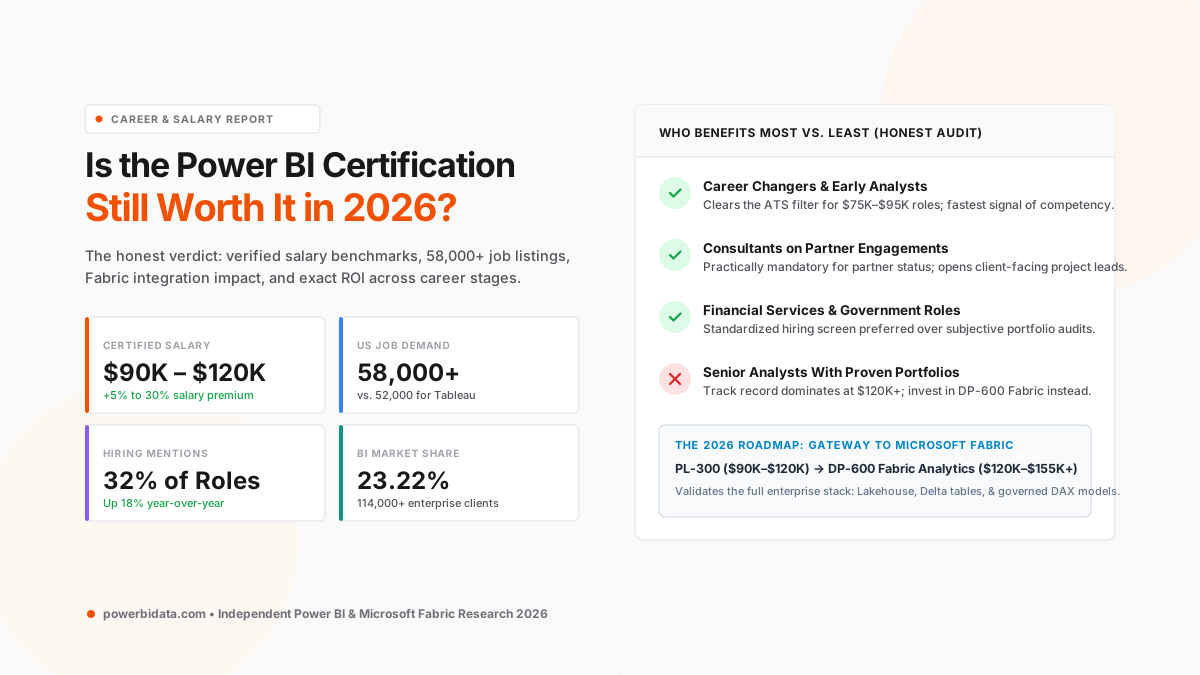
- The honest answer is yes — but not unconditionally: The PL-300 certification pays off most clearly for career changers, consultants on Microsoft partner projects, and analysts in the early-to-mid stages of their career. It pays off least for senior practitioners whose track record already speaks louder than any credential.
- Job market demand is real and growing: As of March 2026, Indeed lists roughly 58,000 US job postings requiring Power BI versus 52,000 for Tableau — a meaningful gap that has widened since 2023, and Power BI certification is explicitly mentioned in 32% of those Power BI job listings, up 18% year-over-year.
- The salary picture is specific, not vague: Certified Power BI analysts in the US earn between $90,000 and $120,000 on average, with a documented premium of 5–30% over uncertified peers depending on experience level. The premium is higher at junior and mid levels; it narrows significantly at senior levels where portfolio and track record dominate.
- Certification alone is not sufficient: Every recruiter and hiring manager interviewed across multiple 2026 sources makes this explicit: a credential clears the resume filter and gets you the interview — a hands-on portfolio and demonstrated DAX/Power Query skills are what get you the offer.
- The Fabric angle changes the calculus: With Power BI now embedded inside Microsoft Fabric, PL-300 is increasingly a gateway credential rather than a destination — the next step, DP-600, positions practitioners for the highest-paying roles in the Microsoft analytics ecosystem.
Certifications generate two kinds of controversy. The first is people who say they're worthless — "employers only care about skills." The second is people who overclaim — "this one certification changed my life." Both camps are wrong, and both are responding to the same underlying truth: a certification is a signal, not a skill. The question isn't whether the signal exists — it clearly does. The question is whether your specific situation is one where that signal moves the needle, and by how much. This guide answers that question with actual data.
What Changed in 2026 That Makes This Question Worth Revisiting
The Power BI certification question has a different shape in 2026 than it did two or three years ago, for three specific reasons that aren't just marketing.
Power BI is now embedded inside Microsoft Fabric. This isn't just a branding change. Fabric is Microsoft's unified data platform, and Power BI is the intelligence and reporting layer sitting on top of OneLake, lakehouses, warehouses, real-time event streams, and AI agents. An analyst who understood Power BI as a standalone reporting tool in 2023 is working with a fundamentally more capable and more complex platform in 2026. The PL-300 exam was updated in April 2025 to reflect this — Microsoft Fabric workspaces, sensitivity labels, and Copilot features are in scope. The credential now tests a broader, more architecturally aware skill set than it did when it was first introduced.
Power BI has shifted from a static reporting tool to a dynamic, AI-driven analytics engine, and the certification reflects that shift. Someone passing PL-300 today is validated on a more complex platform than someone who passed the equivalent DA-100 in 2022.
The job market has tilted definitively toward Power BI over Tableau. As of March 2026, Indeed lists roughly 58,000 jobs requiring Power BI versus 52,000 requiring Tableau in the United States. That gap didn't exist three years ago — Tableau dominated analyst job postings through 2022. The shift reflects both Power BI's expanding capabilities and the gravitational pull of the Microsoft 365 ecosystem, which makes Power BI the default choice for the majority of enterprise environments that already run Azure and Teams.
AI has amplified the need for governance-quality models, not eliminated the analyst. A consistent concern in 2024 and 2025 was whether Copilot and AI assistants would reduce demand for human analysts. The actual picture in 2026 is more nuanced: AI has supercharged Power BI, but has not removed the need for a human analyst. What AI has done is raise the floor — analysts who can only produce basic reports face more competition from automated tools, while analysts who can design governed semantic models, implement RLS, build robust DAX, and manage deployment pipelines have become more valuable, not less, because those are the skills that make AI-generated answers trustworthy. PL-300 tests exactly those deeper skills.
The Honest Salary Picture
Salary data around certifications gets inflated constantly — either by training providers who benefit from overstating the premium, or by aggregation bias where certified candidates also happen to have more experience. Here's what the current data actually says, with the caveats attached.
What Certified Power BI Analysts Earn
Microsoft Power BI Data Analyst (PL-300) holders earn $90K–$120K according to current data from Glassdoor, ZipRecruiter, and BLS.gov. The average US Power BI Data Analyst salary across the broader market sits around $82,640 per year as of May 2026 across reported market data.
That gap — roughly $7,000–$37,000 between the broader market and the certified upper band — reflects both the certification premium and the experience premium. The two are correlated and hard to fully separate.
PL-300 correlates strongly with Data Analyst and BI Developer salaries in the $75,000–$115,000 range in the US. Financial services and consulting tend to pay at the top of this range.
| Role | Typical US Salary Range |
|---|---|
| Power BI Analyst (entry–mid) | $75,000 – $95,000 |
| BI Developer (mid) | $85,000 – $115,000 |
| Senior BI Developer | $105,000 – $135,000 |
| Power BI Consultant (partner firm) | $95,000 – $130,000 |
| Senior Data Analyst + PL-300 + DP-600 | $115,000 – $155,000+ |
The Salary Premium: What the Data Actually Shows
The most cited figure is a 5–30% salary premium for certified versus uncertified practitioners. That range is wide because the premium isn't uniform — it varies significantly by career stage.
At the junior and early-mid level, the premium is most visible and most meaningful. A credential that gets your resume past an ATS filter, into a human reviewer's hands, and into an interview for a $85,000 role has already delivered ROI many times over on a $165 exam fee. If the certification helps you land one job just one week sooner, it has already paid for itself.
At the mid-to-senior level, the premium narrows. Third-party data from Payscale and LinkedIn shows a modest premium — roughly $5–10K for certified versus uncertified at similar experience levels. A senior analyst with 8 years of Power BI experience and a strong portfolio of enterprise dashboards is going to command a competitive salary with or without PL-300. The credential adds credibility, but it isn't the primary driver.
At the senior and leadership level, the premium is smallest. Track record, portfolio quality, architecture decisions, and team leadership weight far more than a certification at this level. The honest answer at $130,000+ is that PL-300 alone isn't the differentiator — DP-600 combined with demonstrated enterprise Fabric experience is.
The Job Market Reality
Numbers are more persuasive than claims, so here's the specific picture.
Out of over 491,000 companies using Business Intelligence tools globally, Microsoft Power BI holds a 23.22% market share, translating to over 114,000 active corporate customers. That corporate customer base is what creates structural demand — organizations that have adopted Power BI at scale need people who can maintain, govern, and build on it. That demand doesn't evaporate when a new tool launches.
Power BI certification is now explicitly mentioned in 32% of Power BI-related job listings, a figure that has grown 18% year-over-year. That means you can search a job board right now and find that nearly one in three Power BI roles either requires or prefers the credential. This is meaningfully higher than where it was two years ago and reflects Microsoft's active push to make PL-300 a standard bar for Microsoft partner engagements.
Power BI is usually the safer starting point in 2026. The market demand is massive. The ecosystem is strong. The learning resources are abundant. The career opportunities are broad.
That last point matters in a specific way: the Microsoft ecosystem creates a compounding advantage. Power BI skills transfer to Microsoft Fabric, to Azure Synapse, to Copilot-enabled workflows. Learning Power BI in 2026 isn't just learning a reporting tool — it's entering an ecosystem where each additional Microsoft certification (DP-600, AZ-900, DP-900) builds on the previous one and where Microsoft partner firms have structural incentives to hire certified practitioners.
Who Benefits Most From the Certification
The certification isn't equally valuable in every situation. Being specific about who it helps most is more useful than a blanket "yes, go get it."
Career Changers Moving Into Analytics
This is where PL-300 delivers the clearest, most measurable value. A career changer — someone moving from finance, operations, project management, or any other field into a data analyst role — faces a specific problem: how to signal credible Power BI skills to hiring managers who don't know them. A portfolio helps, but it takes time to build and interpret. PL-300 is a third-party validated signal from Microsoft itself that the person can do the work.
The certification doesn't replace the portfolio — the two work together. Candidates with both consistently outperform candidates with only one. But for a career changer who has built skills self-taught and wants something to anchor those skills to in a hiring conversation, PL-300 is a meaningful accelerant.
Consultants Working on Microsoft Partner Projects
This is the context where PL-300 is least optional and most literally required. Microsoft partner firms — the consulting companies that implement Power BI and Fabric solutions for enterprise clients — operate under a system where partner status depends partly on the number of certified practitioners on staff. For consultants, it's often required to participate in Microsoft partner projects. "Required" here means required — not preferred, not a nice-to-have. If your firm needs it to maintain partner status, and your firm does Microsoft projects, the question of whether the certification is worth it has already been answered for you.
Analysts at the Early-to-Mid Career Stage
For an analyst two to five years into their career who is building toward a senior or lead BI role, PL-300 serves two functions. It validates skills at a level that resumes and portfolios alone don't always communicate clearly to hiring managers who aren't Power BI experts themselves. And the preparation process itself — which forces systematic study of deployment pipelines, workspace roles, gateway configuration, RLS, and sensitivity labels — regularly surfaces real skill gaps that practitioners who've learned on the job didn't know they had.
Analysts Targeting Financial Services or Government
These two industries use certifications as hiring filters more aggressively than most. Financial services firms, particularly at the enterprise level, rely on certification as a standardized screen because their hiring volumes and regulatory environments create pressure toward verifiable credentials rather than portfolio review. Government agencies operate under procurement and hiring rules that often explicitly reward or require certifications. If your target employer is in either sector, PL-300 carries more weight than it would at a mid-size tech company where the hiring manager will just ask you to write a DAX formula in the interview.
Who Benefits Least
Honest guidance requires saying where the certification doesn't move the needle much.
- Senior analysts with a strong portfolio: If you have five or more years of hands-on Power BI experience and a body of enterprise work — real dashboards, real data models, real deployment decisions — your track record already communicates what PL-300 would communicate. At this level, DP-600 is a more strategic investment than PL-300, since it validates the Fabric-level architecture skills that are genuinely rarer and more valued at senior compensation bands.
- Practitioners whose primary work isn't in Power BI: You already have the job and your employer uses internal skills assessments, or your work is primarily in Tableau, Looker, or another BI tool where PL-300 is irrelevant. PL-300 validates a specific skill set on a specific platform. If the platform isn't central to your work, the credential doesn't transfer.
- Anyone treating certification as a substitute for hands-on experience: The badge alone will never secure a senior-level position if the actual portfolio is empty. Hiring managers who interview Power BI candidates — especially at companies that actually use it at scale — will ask you to explain DAX formula logic, debug a broken relationship, or describe a data modeling decision you made. A credential without the underlying skill is a liability in that conversation, not an asset.
Power BI vs. Tableau in 2026: Which Certification First?
This question comes up consistently alongside the "is it worth it" question, so it's worth addressing directly rather than leaving it as an implied comparison.
Through 2022, Tableau dominated data analyst job postings. Since 2023, Power BI has pulled ahead and continues to grow. That reversal reflects both the Microsoft ecosystem effect and Tableau's acquisition by Salesforce — which has strengthened Tableau's position in Salesforce-heavy environments while making it less universally relevant across the broader enterprise market.
The split today is genuinely industry-specific. Power BI dominates Microsoft-shop industries (manufacturing, finance, healthcare, government) and small-to-mid-market companies generally. Tableau is still the leader at large tech companies, consulting firms, and established enterprises with mature data teams.
The practical decision rule: look at the three to five companies you most want to work for. If the job descriptions list Power BI, start with PL-300. If they list Tableau, start with Tableau Desktop Specialist. If they list both, Power BI is the higher-probability bet for most markets because the job volume is larger and the credential is explicitly requested more frequently.
The one scenario where Tableau first makes clear sense: if your target companies are large tech, advertising, or media firms that have historically invested in Tableau, or if you're targeting roles at firms with Salesforce as a core platform. In those environments, Tableau's market position is still very strong.
The Fabric Angle: Why PL-300 Is a Starting Point, Not a Destination
This is the context shift that makes 2026 a particularly good time to certify in Power BI — not because PL-300 alone is more valuable than it was, but because of what it positions you for next.
With Power BI embedded inside Microsoft Fabric, the analytics practitioner who understands Power BI semantic models, data governance, and the relationship between OneLake and the reporting layer has a genuine foundation for the Fabric ecosystem. The DP-600 exam — which earns the Microsoft Certified: Fabric Analytics Engineer Associate — tests exactly that expanded Fabric layer, including Lakehouse architecture, Delta tables, real-time analytics, and data pipelines alongside the Power BI modeling skills that PL-300 already validates.
The practical answer for a first certification in 2026: for the broad US market and most career changers, Power BI is the higher-probability bet, and Microsoft Fabric and Copilot integration are widening that lead.
The two-certification path — PL-300 followed by DP-600 — positions practitioners for the highest-paying roles in the Microsoft analytics ecosystem. Senior Fabric Analytics Engineers with both credentials regularly command $120,000–$155,000+ in the current US market, a range that reflects the genuine scarcity of people who understand the full stack from data ingestion through semantic modeling through governance and deployment.
How to Get the Most Out of the Certification: A Decision and Action Framework
If you've read this far and concluded the certification is worth pursuing, here's how to approach it in a way that maximizes the return on your 80–120 hours of preparation time.
Step 1: Audit Your Current Skill Level Honestly
Take Microsoft's free PL-300 practice assessment before you buy study materials or book the exam. The assessment is available directly on the PL-300 certification page on Microsoft Learn, takes roughly 30 minutes, and gives you a domain-by-domain readiness score. This tells you where you actually are rather than where you think you are.
If your practice assessment score is below 60% on any single domain, budget extra time there before moving on. Most people discover they're stronger on visualization than on the operational domain (workspace roles, gateway configuration, deployment pipelines) — the domain most commonly underestimated in study planning.
Step 2: Map Your Study Time to the Domain Weights
The four exam domains and their weightings directly determine how to allocate your preparation hours. Spending 40% of your study time on visualization (the most comfortable domain for most candidates) when it represents 25–30% of the exam, while underinvesting in modeling and DAX (also 25–30%), is one of the most common preparation mistakes.
A practical allocation for someone with 80 hours of total study time:
| Domain | Exam Weight | Suggested Hours |
|---|---|---|
| Prepare the Data | 25–30% | 18–22 hours |
| Model the Data (incl. DAX) | 25–30% | 22–26 hours |
| Visualize and Analyze | 25–30% | 18–22 hours |
| Deploy and Maintain | 15–20% | 12–16 hours |
The modeling domain gets slightly more time than its weight suggests because DAX proficiency is where the largest skill gaps typically exist and where exam questions are most technically demanding. You can read about DAX functions in a few hours; genuinely understanding filter context well enough to predict a formula's output in an exam scenario takes practice time that can't be compressed.
Step 3: Build, Don't Just Read
The most consistent finding across PL-300 candidate reports is that reading and watching videos produces a different, less exam-ready preparation than hands-on building. For every concept you study, build a working version of it.
Read about row-level security — then create a static RLS role, publish it, and test it with the "View as" feature in Power BI Service. Read about deployment pipelines — then set one up with a development and production stage and deploy content between them. Read about gateway configuration — then install a personal gateway on your machine and connect a local data source through it.
This hands-on loop is what makes the operational domain questions feel familiar on exam day rather than abstract. The exam frequently presents a scenario — "a scheduled refresh is failing after a gateway was updated; what should be checked first?" — that reads as obvious if you've actually configured and troubleshot a gateway, and reads as guesswork if you've only read about it.
Step 4: Practice Under Exam Conditions Before Booking
Two weeks before your planned exam date, run at least two timed practice sessions under actual exam conditions — no notes, no browser, 60 minutes per session. Score them honestly using the domain weightings rather than just a raw percentage. Any domain scoring below 70% in practice requires targeted review, not a broad reread of everything.
Use Microsoft's Exam Sandbox to familiarize yourself with the interface, the question navigation, the flag-for-review workflow, and the way case study questions are structured. The exam interface itself is learnable with 30 minutes of practice; encountering it for the first time on exam day wastes time and focus you need for the questions themselves.
Step 5: Publish Your First Report Before You Book the Exam
The single most practical thing you can do in the week before your exam — that has nothing to do with studying — is to publish a complete end-to-end Power BI report to Power BI Service. Connect to a real dataset, build a meaningful report, configure a scheduled refresh, set up workspace sharing, create an app from the workspace, and apply a sensitivity label if your organization uses them.
This loop — build, publish, share, govern — is what the operational domain tests. Running through it once in real life makes the exam questions about it feel like recall rather than inference. It also gives you something concrete to discuss in the hiring conversation that inevitably follows passing the exam.
The Honest ROI Calculation
Here's the actual investment and return, stated plainly.
Cost: $165 exam fee. 80–120 hours of preparation time (valued at your current hourly rate). Free renewal every 12 months through Microsoft Learn.
Return scenarios:
- For a career changer landing a Power BI Analyst role at $85,000 instead of being filtered out at the resume stage: the return on $165 and 80 hours of study is effectively the difference between having the job and not having it. Even a one-month salary acceleration — getting hired four weeks earlier — represents roughly $7,000 in additional earnings against a $165 cost.
- For a mid-level analyst negotiating a new role: a 5–10% salary premium on a $90,000 salary is $4,500–$9,000 annually. At $165 for the exam, the payback period is less than two weeks of that incremental salary.
- For a consultant maintaining Microsoft partner firm status: the return isn't a salary premium — it's continued access to the project types the firm depends on. The exam fee is effectively a license to do the work.
- For a senior practitioner who already earns $120,000+: the incremental value of PL-300 specifically is lower. DP-600 combined with demonstrated Fabric architecture experience is the higher-leverage investment at this level.
In Practice: Three Real Career Scenarios
Scenario 1 — The Career Changer
A marketing analyst with four years of Excel and basic SQL experience wants to move into a data analyst role. She takes PL-300 after three months of study, passes on her first attempt, and lists it on her LinkedIn profile. Within six weeks she receives three interview invitations from roles that specifically listed Power BI certification as preferred. She attributes her first role at $82,000 directly to the credential getting her resume past the initial filter. Two years later, she's earning $97,000 as a senior analyst and preparing for DP-600.
Scenario 2 — The Mid-Level Analyst
A BI developer at a manufacturing company has been using Power BI for three years but never certified. His company begins pursuing Microsoft partner status, and PL-300 is listed as a requirement for practitioners participating in external Microsoft projects. He studies for six weeks, passes, and the certification enables him to lead client-facing Power BI engagements rather than only internal ones — a shift that results in a $12,000 raise within twelve months.
Scenario 3 — The Senior Practitioner
A data architect with eight years of Power BI experience and a portfolio of enterprise semantic models concludes that PL-300 at his career stage adds relatively little signal. Instead he pursues DP-600 directly, which validates Fabric-level architecture skills that are genuinely scarcer in the market. He passes DP-600, moves to a senior Fabric Analytics Engineer role, and earns $145,000 — not because of the credential, but because of the skills the credential validated.
Frequently Asked Questions
Is Power BI certification worth it in 2026?
Yes, with specificity. It's most worth it for career changers, consultants on Microsoft partner projects, and early-to-mid career analysts. It's least worth it for senior practitioners whose portfolio already communicates the same signal more powerfully, and for people working primarily in non-Power BI BI tools.
How long does it take to prepare for PL-300?
Most candidates with 6+ months of hands-on Power BI experience prepare in 4–8 weeks at 1–2 hours per weekday. Candidates with less hands-on experience should budget 8–12 weeks or 100–120 hours total. Hands-on practice with the actual platform matters more than passive reading or video watching.
Does the PL-300 certification increase salary?
The documented premium ranges from 5–30% depending on career stage, industry, and market. The premium is largest at the junior-to-mid level and smallest at the senior level. Certified practitioners in the US earn between $90,000 and $120,000 on average across reported market data in 2026.
Is Power BI in demand in 2026?
Yes. 58,000 US job postings require Power BI as of March 2026, Power BI holds a 23% global BI market share, and demand has grown consistently since 2023 when Power BI overtook Tableau in total job postings. The integration with Microsoft Fabric and Microsoft 365 Copilot is strengthening Power BI's enterprise position further.
Is PL-300 better than Tableau certification?
For most US job seekers in 2026, yes — Power BI has more total job postings and is explicitly requested in a higher percentage of relevant role descriptions. The exception is large tech companies, advertising firms, and Salesforce-heavy environments, where Tableau remains dominant. The right answer depends on which specific companies you're targeting.
What certification comes after PL-300?
DP-600: Implementing Analytics Solutions Using Microsoft Fabric, which earns the Microsoft Certified: Fabric Analytics Engineer Associate credential. It validates the expanded Fabric layer — lakehouses, data pipelines, real-time analytics — that sits above the Power BI semantic modeling skills PL-300 already tests. Senior Fabric Analytics Engineers with both credentials command $120,000–$155,000+ in the current US market.
Recommended Next Guides & Deep Dives
Continue expanding your Power BI and Fabric architecture knowledge with these closely connected tutorials:
-
PL-300 Certification Guide 2026: Exam Domains & Study Plan
→
Complete breakdown of exam topics, free sandbox tests, and preparation steps.
-
Power BI Copilot vs Fabric Data Agents
→
Understand how agentic AI and Fabric skills impact modern BI hiring.
-
Mastering DAX in Power BI: Ultimate 2026 Guide
→
Master the technical evaluation context concepts tested heavily in interviews.
-
What Is Fabric IQ in 2026?
→
Stay ahead of the curve as enterprise certifications expand into Fabric.
-
Profit and Loss Dashboard in Power BI
→
Build an impressive portfolio showcase project to prove real enterprise competence.

Vivek Dhumal
BI Consultant
BI Consultant & Power BI Developer
Vivek Dhumal is a dedicated BI Consultant and Data Analyst specializing in Power BI development, DAX calculations, SQL data modeling, ETL automation, and scalable business intelligence solutions.